I see many hospital directors struggling with failing sewage systems. Overlooking simple flow math leads to fines and shutdowns. Let me show you how to get these numbers right.
To calculate hospital wastewater capacity, multiply the number of beds by a flow rate of 400-500 liters per day. Then, add staff and visitor usage, apply a peak factor of 2.5-4.0, and include a 15% safety margin for future expansion.
I know you are busy running a hospital, but understanding these numbers is the only way to stay compliant with local environmental laws. If you guess wrong, your facility could face heavy fines or even be forced to close. In my years at ROAGUA, I have helped many doctors in Africa and the Middle East avoid these exact problems by using a clear, step-by-step sizing method.
What is the average daily wastewater volume for a 100-bed private clinic?
You might think a 100-bed clinic needs a small system. But if you underestimate the daily flow, your drains will overflow. I have seen this happen far too often in busy private clinics.
A 100-bed private clinic typically generates between 40 to 50 cubic meters (40-50 KLD) of wastewater daily. This estimate uses a standard rate of 400-500 liters per bed, covering patient care, laundry, and basic cleaning services.
Why the Per-Bed Number Matters
When I talk to hospital owners, I always start with the “per-bed” metric. This is the industry standard. For a hospital with fewer than 100 beds, we usually see about 350 to 400 liters used per bed every day. However, as the hospital grows to 200 beds, that number often jumps to 450 or 500 liters. This happens because larger hospitals usually have more specialized departments like surgery, laundry, and large kitchens.
You must remember that not all water used in the hospital becomes wastewater. We use a “conversion factor” of about 0.8 or 0.9. This means that if your hospital uses 1,000 liters of fresh water, about 800 to 900 liters will go down the drain as sewage. The rest is lost to evaporation in air conditioning units or used for watering the hospital gardens.
Breaking Down the Flow by Hospital Size
To make this easier for you, I have created a table that shows the expected flow for different sizes. These numbers include the 0.8 conversion factor and assume a full house of patients.
| Hospital Size (Beds) |
Estimated Daily Water Use (Liters) |
Average Wastewater Flow (KLD/m³ per day) |
| 50 Beds |
17,500 – 20,000 |
14 – 18 |
| 100 Beds |
40,000 – 50,000 |
32 – 45 |
| 150 Beds |
60,000 – 75,000 |
48 – 67 |
| 200 Beds |
90,000 – 100,000 |
72 – 90 |
Accounting for Non-Patient Sources
You cannot just look at the beds. Your staff and daily visitors also contribute to the waste. In many African hospitals, family members often stay with the patients. This adds a lot of extra water use. I recommend adding 50 to 100 liters per day for every staff member and outpatient. If your 100-bed hospital has 50 staff members and 100 outpatients a day, you could be adding another 7 to 15 cubic meters of waste daily. This is why a “one-size-fits-all” machine usually fails. We must look at how your specific hospital operates every day.
How do I determine the peak flow rate for my hospital’s drainage system?
Your system might work fine at midnight, but what about the morning rush? I hate seeing pumps burn out because they cannot handle the 8 AM surge of water.
Determine peak flow by multiplying your average daily flow by a peaking factor, usually between 2.5 and 4.0. For a 100-bed hospital, an average flow of 50 m³/day results in a peak hourly flow of roughly 6.25 to 8.3 cubic meters per hour.
The Reality of Morning Surges
In a hospital, water use is not spread evenly over 24 hours. Most of the wastewater is generated during the day. Think about the morning routine. Nurses are washing patients, the laundry is running at full speed, and the kitchen is preparing breakfast. This creates a massive “surge” in the pipes. If your treatment plant is only sized for the average flow, the water will move through the tanks too fast. This means the bacteria won’t have time to clean the water, and you will end up discharging dirty sewage.
To prevent this, we use a formula to find the Peak Hourly Flow ($Q_{peak}$):
$$Q_{peak} = \frac{Q_{avg} \times \text{Peak Factor}}{24}$$
Choosing the Right Peak Factor
The smaller the hospital, the higher the peak factor needs to be. This is because a single large event—like a laundry cycle—has a bigger impact on a small system. For a 50-bed hospital, I often use a peak factor of 4.0. For a 200-bed hospital, we might drop it to 2.5 or 3.0 because the flow is more “smoothed out” across more beds.
| Hospital Size (Beds) |
Average Flow (m³/day) |
Recommended Peak Factor |
Peak Hourly Flow (m³/h) |
| 50 |
20 |
4.0 |
3.33 |
| 100 |
50 |
3.0 |
6.25 |
| 200 |
100 |
2,5 |
10.42 |
Why This Matters for Equipment Choice
Knowing the peak flow helps us choose the right size for your pumps and your “Equalization Tank.” The Equalization Tank is like a big buffer. It catches the morning surge and holds the water, letting it flow into the treatment system at a steady, slow pace. If I see a hospital with a small buffer tank, I know they will have trouble with compliance. My goal is to make sure your system runs quietly and steadily, no matter how many people are using the bathrooms or the showers.
Will my current system be enough if I increase my bed capacity next year?
I often talk to owners who plan to expand but forget their sewage plant. Buying a system that is too small today means you will pay double later on.
Your current system will only suffice if it was originally designed with a 20-30% safety margin. If you plan to double your beds from 100 to 200, you must upgrade your treatment capacity to handle at least 100-120 KLD total.
Planning for the Future
Most of the doctors I work with in Nigeria and Kenya are very successful. Their hospitals grow quickly. If you have 50 beds now but plan to add another floor next year, do not buy a 20 KLD system. You should buy a system designed for 100 beds from the start. It is much cheaper to buy one larger unit now than to buy a second one and try to connect them later.
I always suggest adding a 15% safety margin on top of your highest predicted flow. This accounts for “Infiltration.” Infiltration is when rainwater or groundwater leaks into your old pipes. During a heavy rainstorm, your wastewater volume can double in an hour. If you don’t have that extra 15% capacity, your plant will overflow.
The Modular Solution
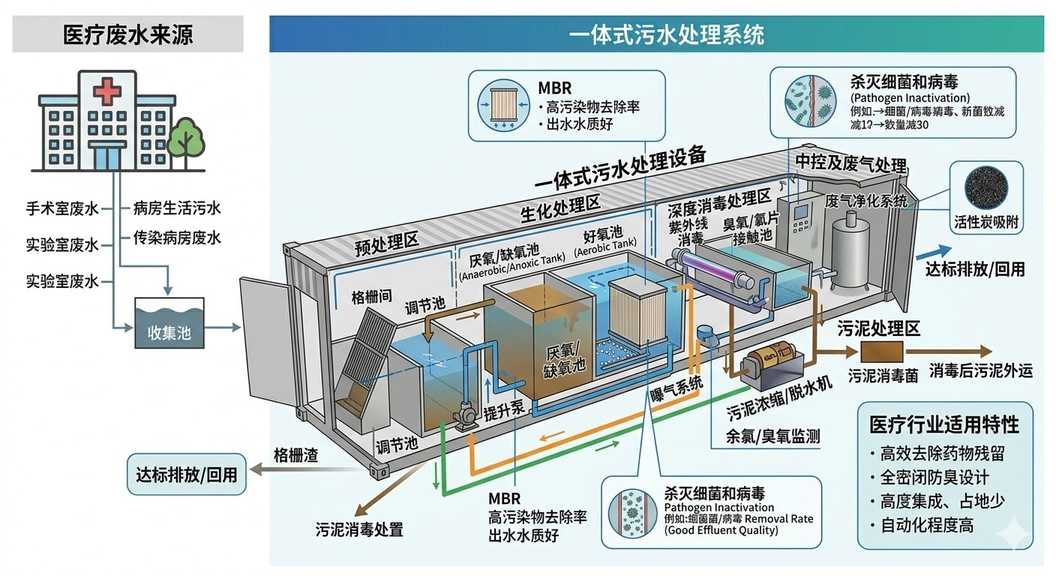
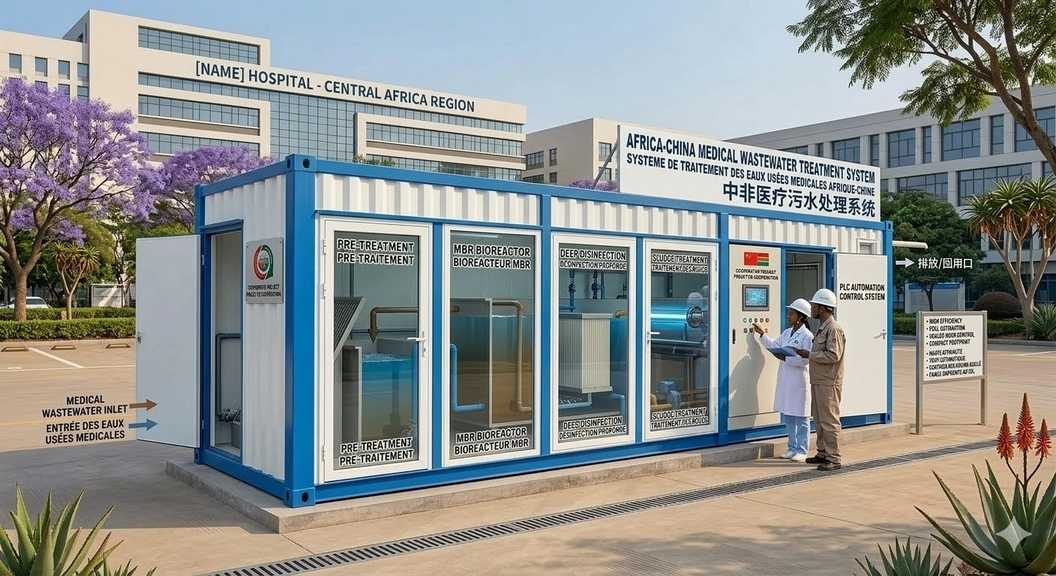
At ROAGUA, we prefer building “Integrated” или “Containerized” systems. These are built inside steel boxes or tanks in our factory in China. For a hospital that is growing, we can design the layout so that you can add a second “module” later. This keeps your initial cost lower but gives you a clear path for growth.
The True Cost of Under-Sizing
If you use a system that is too small, three bad things happen:
- The Bacteria Die: If you push too much water through, the “good” bacteria that eat the waste get washed away.
- The Smell: Overloaded systems smell like rotten eggs. This is terrible for a hospital environment where hygiene is everything.
- Legal Trouble: When the government inspector takes a sample, it will fail. In many countries, this leads to immediate fines that are often more expensive than the equipment itself.
- I tell my clients to think of the wastewater system like the hospital’s heart. If the heart is too small for the body, the whole system fails.
What size of treatment equipment do I need to meet my local discharge standards?
Local authorities in Africa and the Middle East are getting stricter. I don’t want you to face legal action because your treated water still contains dangerous bacteria.
To meet discharge standards, you need equipment sized for both volume and “loading.” For a 150-bed hospital, a 75-90 KLD system with advanced disinfection is required to ensure BOD levels stay below 10 mg/L and all pathogens are killed.
Volume vs. Quality
Sizing isn’t just about how many cubic meters of water you have. It is also about what is in the water. Medical wastewater is “stronger” than normal house waste. It contains blood, chemicals from the lab, and many antibiotics. These things are hard to break down.
If your local law says your Biological Oxygen Demand (BOD) must be under 10 mg/L, a simple septic tank will not work. You need an Advanced Oxidation process or a Membrane Bioreactor (MBR). These systems are more compact and do a much better job of cleaning the water. I usually recommend MBR for hospitals because it acts as a physical filter, catching bacteria and even some viruses.
Meeting Local Standards
Every country has different rules. I have worked with the standards in many regions. Here is a comparison of what we usually see:
| Параметр |
Standard Level (Strict) |
Why it Matters for Hospitals |
| BOD5 |
< 10 mg/L |
Ensures no organic rot in the local rivers. |
| ХПК |
< 50 mg/L |
Measures chemical waste from labs/cleaning. |
| ТСС |
< 10 mg/L |
Keeps the water clear and prevents pipe clogs. |
| Fecal Coliform |
< 100 MPN/100mL |
Ensures no disease-causing germs are released. |
The Importance of Disinfection
For a medical facility, the most critical part of the equipment size is the disinfection stage. Even if the water looks clear, it could have dangerous germs. We size our chlorine or UV (Ultraviolet) systems to be 20% larger than the peak flow. This ensures that every single drop of water stays in contact with the disinfectant for long enough to kill all pathogens.
I always tell Dr. Samuel and my other clients that “safety first” is the only rule in medical waste. Our systems use automated dosing. This means your staff doesn’t have to touch chemicals or guess how much to add. It’s a “подключи и работай” solution that lets you focus on your patients while the machine takes care of the environment.
Correctly sizing your hospital’s wastewater system ensures legal compliance and safety. By calculating average flows, applying peak factors, and planning for growth, you protect your facility and your community.
Would you like me to create a customized capacity calculation sheet for your specific hospital beds and staff numbers?