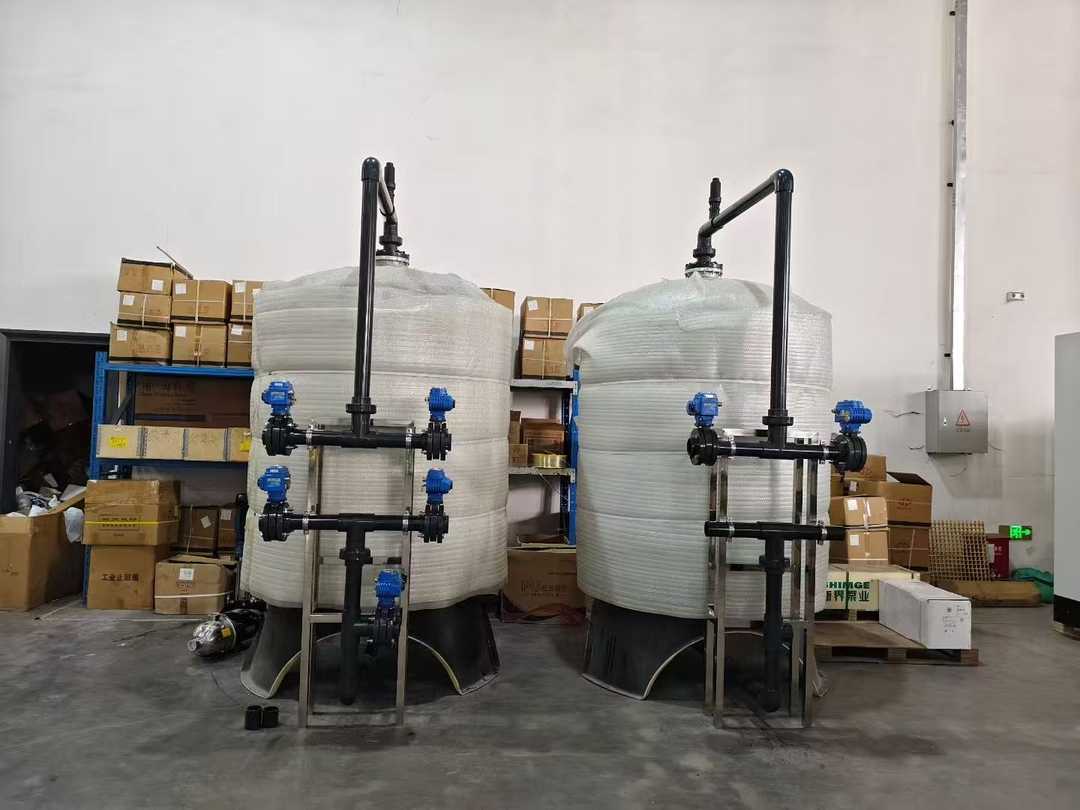
Los filtros multimedia son uno de los más utilizados. sistemas de pretratamiento en agua y tratamiento de aguas residuales. Desempeñan un papel fundamental en la eliminación de sólidos suspendidos, la reducción de la turbidez y la protección de equipos posteriores como sistemas de ósmosis inversa (RO).
En este artículo, explicaremos el Principios de diseño, mecanismo de trabajo, selección de medios filtrantes y proceso de retrolavado. de filtros multimedia de forma clara y práctica.
¿Qué es un filtro multimedia?
A filtro multimedia (MMF) Utiliza dos o más tipos de medios de filtración bajo presión para eliminar las impurezas suspendidas del agua.
El agua pasa a través de un lecho filtrante en capas hecho de materiales granulares, eliminando eficazmente:
- Sólidos suspendidos (SS)
- Partículas coloidales
- Turbiedad
- Parte de la materia orgánica (DBO, DQO)
👉 Después de la filtración, la turbidez del agua normalmente se puede reducir a por debajo de 3 NTU.
Medios filtrantes comunes utilizados
Los materiales de filtración típicos incluyen:
- Arena de cuarzo
- Antracita
- Arena de manganeso
- Carbón activado
- Granate
- Magnetita
- Medios cerámicos o plásticos.
Cada material tiene diferentes Densidad, tamaño de partículas y función de filtración..
Cómo funciona la filtración multimedia
La filtración en el tratamiento de agua se refiere al proceso donde Las capas de medios porosos capturan partículas suspendidas. mientras el agua fluye a través de ellos.
El mecanismo incluye:
- Interceptación mecánica
- Adsorción
- Sedimentación dentro del lecho filtrante.
En comparación con los filtros de una sola capa, los filtros multimedia proporcionan:
✔ Mayor eficiencia de filtración
✔ Mejor calidad del agua
✔ Mayor capacidad de retención de suciedad
Estructura de un filtro multimedia
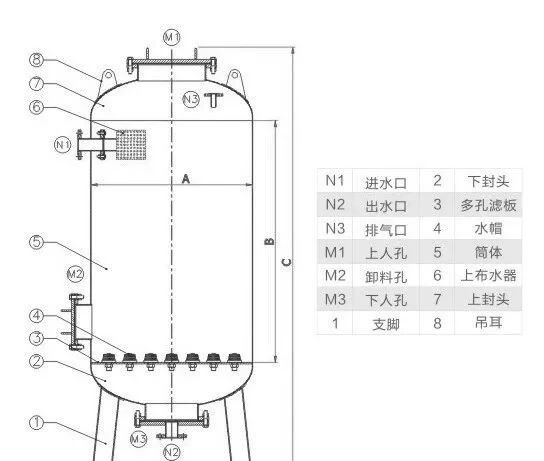
Un sistema de filtrado multimedia típico consta de:
- Recipiente de filtrado (tanque)
- Sistema de distribución interna
- Capa de soporte (grava)
- Capas de medios filtrantes
- Sistema de retrolavado de aire y agua.
- Válvulas y tuberías externas.
- Válvula de liberación de aire
Criterios de selección de medios filtrantes
Al seleccionar medios filtrantes, los siguientes factores son críticos:
- Alta resistencia mecánica (resistente al desgaste durante el retrolavado)
- Buena estabilidad química
- No tóxico y seguro para el tratamiento del agua.
- Alta capacidad de adsorción y eliminación de suciedad.
- Capacidad para ofrecer una alta eficiencia de filtración
Principios de diseño del lecho filtrante
El diseño de un lecho filtrante multimedia se basa en:
1. Diferencia de densidad
Los diferentes medios deben tener diferencias de densidad suficientes para evitar que se mezclen durante el retrolavado.
2. Distribución del tamaño de las partículas
- Capa superior: mayor tamaño de partículas, menor densidad
- Capa inferior: tamaño de partícula más pequeño, mayor densidad
3. Estructura típica de tres capas
Una configuración estándar incluye:
- capa superior: Antracita o carbón activado (filtración gruesa)
- capa media: Arena de cuarzo (filtración intermedia)
- capa inferior: Magnetita o granate (filtración fina)
👉 Esta estructura en capas asegura filtración de lecho profundo, mejorando significativamente la calidad del agua en comparación con los filtros de una sola capa.
Relación entre el tamaño del medio y la profundidad de la cama
La proporción de profundidad del lecho filtrante al tamaño del medio normalmente es:
👉 800–1000:1
Esto garantiza una eficiencia de filtración óptima y una retención adecuada de partículas.
Filtro de arena de cuarzo: características clave
Los filtros de arena de cuarzo son el tipo de filtro multimedia más utilizado.
Ventajas:
- Alta precisión de filtración
- Pérdida de presión baja
- Fuerte resistencia a ácidos y álcalis.
- Amplio rango de pH (2–13)
- Buen rendimiento anticontaminación
Pueden eliminar eficazmente:
- Sólidos en suspensión
- coloides
- hierro y manganeso
- Contaminantes orgánicos
- Bacterias y virus.
Filtro de carbón activado: función de adsorción
Los filtros de carbón activado se utilizan principalmente para:
- Quitar color y olor
- Eliminación del cloro residual
- Adsorber compuestos orgánicos (p. ej., fenoles, benceno)
Beneficio clave:
Debido a su gran superficie y estructura porosa, el carbón activado tiene excelente capacidad de adsorción.
👉 Es muy utilizado en:
- tratamiento de agua potable
- Industria alimentaria
- Procesamiento químico
- Plantas de energía
Proceso de retrolavado: por qué es necesario
Durante el funcionamiento, los contaminantes se acumulan en el lecho filtrante y provocan:
- Mayor caída de presión
- Caudal reducido
- Deterioro de la calidad del agua.
👉El retrolavado es fundamental para restablecer el rendimiento del filtro.
Principio de retrolavado
El retrolavado invierte el flujo de agua a través del lecho filtrante:
- Expande y fluidifica los medios.
- Elimina partículas atrapadas
- Elimina los contaminantes del sistema.
Métodos de retrolavado
1. Retrolavado Aire + Agua (Recomendado)
- El aire afloja el lecho filtrante.
- El agua se lleva los contaminantes.
- El efecto combinado mejora la eficiencia de limpieza.
2. Primero aire, luego agua
- La agitación del aire rompe la suciedad de la superficie.
- El agua enjuaga los contaminantes
Parámetros clave de retrolavado
- Tasa de expansión: 40–50% (medios duales)
- Intensidad del agua: ~40 m³/(m²·h)
- Presión de agua: ≤ 0,15MPa
- Intensidad del aire: ~15 m³/(m²·h)
- Presión de aire: ≤ 0,15MPa
Problemas comunes: Apelmazamiento del medio (formación de bolas de lodo)
Las causas incluyen:
- Distribución desigual del aire
- Lavado a contracorriente incompleto
- Acumulación de contaminación por aceite
- Sistema de drenaje inferior dañado u obstruido
👉 Con el tiempo, esto conduce a:
- Eficiencia de filtración reducida
- canalización
- Fallo del sistema
¿Cuándo se debe realizar un retrolavado?
El retrolavado se desencadena por:
- Mayor caída de presión
- Disminución de la calidad de los efluentes
- Intervalos de tiempo de filtración fijos
Aplicaciones de filtros multimedia
Los filtros multimedia se utilizan ampliamente en:
- Tratamiento de aguas industriales
- Plantas de tratamiento de aguas residuales
- Sistemas de pretratamiento RO
- Suministro de agua municipal
- Plantas de energía
- Alimento & industria de las bebidas
- Filtración de piscinas
Los filtros multimedia son un componente crítico en los sistemas de tratamiento de agua, proporcionando una eliminación fiable de sólidos suspendidos y protegiendo los procesos posteriores.
Optimizando:
- Selección de medios filtrantes
- Diseño de capas
- Proceso de retrolavado
👉 Puedes mejorar significativamente Eficiencia del sistema, calidad del agua y vida útil operativa..
¿Necesita una solución de filtro multimedia?
En ROAGUA, proporcionamos:
- Sistemas de filtración multimedia diseñados a medida
- agua industrial & soluciones de tratamiento de aguas residuales
- Diseño del sistema de pretratamiento RO
👉 Contáctenos hoy para una Solución profesional adaptada a las necesidades de su proyecto..