April 7, 2026     Сообщение от :

I know the stress of running a busy hospital in a crowded city. You face strict environmental rules and have almost no ground space left for a big treatment plant. It feels like a trap when the government demands clean water but you have no room to build.

Installing a compact wastewater system requires using Membrane Bioreactor (MBR) technology or modular containerized units. These systems save up to 50% more space than old methods. You can fit them into basements, parking lots, or even on rooftops by using vertical designs and customized equipment layouts.

I want to help you solve this space puzzle. Below, I will show you exactly how we at ROAGUA design these systems to fit into tight corners while keeping your hospital safe and compliant.

What is the smallest footprint available for a high-capacity medical water system?

I often meet hospital directors who think a high-capacity system must be huge. They worry they will have to tear down a wing of the hospital just to stay legal. I tell them that with MBR technology, we can shrink a massive plant into a tiny footprint.

The Membrane Bioreactor (MBR) system offers the smallest footprint for high-capacity medical wastewater treatment. It combines biological treatment and high-end filtration into one step, removing the need for large settling tanks. This design can reduce the total land area needed by 40% to 60% compared to traditional systems.

Understanding MBR for Tight Spaces

When I talk to clients like Dr. Samuel, I explain that traditional wastewater treatment is like an old, bulky desktop computer. MBR is like a slim, powerful laptop. In a traditional system, you need a big tank for thebugsto eat the waste and another huge tank for the water to sit still so the dirt can sink. This sinking process takes a lot of time and a lot of space.

In our ROAGUA MBR systems, we use special membranes. These are like very fine filters that pull the clean water through while leaving the waste behind. Because we use these membranes, we can keep a lot morecleaning bacteriain a much smaller tank. This means the tank can be small, but it can process a huge amount of hospital waste every day.

Comparison of Space and Efficiency

To help you see the difference, look at how different technologies use your land. This is important when every square meter of your hospital property is worth a lot of money.

Technology Type Необходимо пространство Качество воды Maintenance Level
Traditional Activated Sludge Very Large Basic Середина
MBBR (Moving Bed) Середина Хороший Низкий
MBR (Membrane) Smallest Отличный High/Automated

Why MBR Fits Hospitals Best

I recommend MBR not just because it is small, but because it is smart. In a hospital, your wastewater is full of dangerous things like bacteria, viruses, and leftover medicine. A small, traditional system might not catch everything. Our MBR systems act as a physical barrier. The holes in the membrane are so tiny that most bacteria cannot pass through.

This gives you two wins: you save space, and you get water that is clean enough to use for flushing toilets or watering the hospital gardens. Thisone-stoptreatment is perfect for urban hospitals where you cannot afford to have five different giant tanks sitting in your backyard.

Can I customize the equipment layout to fit my hospital’s basement or parking lot?

I have seen many hospitals in Africa and the Middle East where the only free space is a dark basement or a corner of a parking lot. Many suppliers saynoto these odd shapes. I say “да” because our engineering team loves the challenge of a custom fit.

Yes, you can customize the equipment layout by using modular skid-mounted units or integrated containers. These units can be arranged inLshapes,Ushapes, or even stacked vertically. This flexibility allows the system to fit around existing pillars in a basement or sit along a narrow fence in a parking lot.

Breaking theBoxMindset

When we design for a basement, I make sure my team looks at more than just the floor space. We look at the height of the ceiling and the width of the doors. If you have a basement with low ceilings, we can use several shorter tanks connected in a row instead of one tall tank. This is what I mean bycustomization.We don’t just sell you a standard box; we build a system that fits your specific room.

For parking lots, I often suggest our containerized systems. We can paint the container to match your hospital building so it doesn’t look like an ugly piece of machinery. We can place it in a narrow strip of land that you aren’t using for cars. Because the system isintegrated,all the pumps, filters, and wires are already inside the box when it arrives from our factory in China.

Solving the Installation Headache

I know that bringing big equipment into an active hospital is a nightmare. You can’t stop the doctors from working just to move a tank. To solve this, we design our systems inskids.A skid is a metal frame that holds a part of the system.

  1. Modular Delivery: We ship the system in pieces that can fit through a standard double door or down a service elevator.
  1. On-Site Assembly: Once the pieces are in your basement, our team or your local engineers simply bolt them together and connect the pipes.
  1. No Heavy Construction: You don’t need to pour a massive new concrete foundation or build a new building. The skid or the container is the building.

Dealing with Basement Risks

If you put a system in a basement, I always warn about two things: smell and noise. Nobody wants a hospital that smells like a sewer. We use sealed tanks and high-quality air filters (like carbon filters) to make sure the air in the basement stays fresh. We also use quiet blowers so that the patients in the rooms above don’t hear a constant humming sound. This attention to detail is why our custom layouts work where others fail.

How do I optimize my limited hospital land for water treatment?

I see so many hospitals wasting land because they use old-fashioned designs. They have separate tanks for every step of the process. I tell my clients that if they want to optimize their land, they need to stop thinkingwideand start thinkingdeep” или “high.

To optimize limited hospital land, you should use vertical tank stacking or underground installation. Placing the main treatment tanks underground allows you to use the surface for parking or walkways. Above ground, stacking modules vertically uses height instead of horizontal land, doubling your treatment capacity on the same footprint.

Going Underground to Save the Surface

If your hospital land is worth millions, why waste it on a visible sewage plant? I often recommend asemi-buried” или “fully burieddesign. We build the heavy steel or concrete tanks underground. On top, we can put a reinforced cover. You can then drive cars over it or plant a lawn.

Only the control panel and the chemical dosing pumps stay above ground in a small, neat cabinet. This is the ultimate way to optimize land because you essentiallyhidethe wastewater plant.

Vertical Design Strategies

When going underground is too expensive or difficult due to rocks, I suggest going up. Most urban areas allow you to build several meters high. We can stack a 20-foot container on top of another 20-foot container.

  • Bottom Level: Heavy biological tanks and sludge storage.
  • Top Level: Clean water storage, MBR membrane racks, and the control room.

Thistwo-storyapproach means you only use half the ground space. It also makes gravity work for you, which can save a little bit on your electricity bill for pumping water.

Smart Land Usage Comparison

Here is how we look at land optimization when we plan your project. I want you to see how much room you can save.

Особенность Standard Layout Optimized Layout (ROAGUA) Land Saving
Tank Orientation Horizontal / Side-by-side Vertical / Stacked 50%
Piping External / Spread out Internal / Compact 15%
Control Area Separate Building Integrated Cabinet 10%
Total Land Use 100% 25% – 40% Up to 75%

The Role of Automation in Saving Space

I also tell Dr. Samuel that automation saves space. How? Well, if a system is manual, you need bigbuffer tanksto hold water in case the operator makes a mistake or gets busy. With our ROAGUA PLC (Programmable Logic Controller) systems, the machine monitors itself 24/7. It adjusts the flow perfectly. Because the control is so precise, we can use smaller tanks. We don’t need a hugesafety marginbecause the computer doesn’t get tired or forget to turn a valve.

Which design offers the best performance for a city hospital with no extra land?

I have worked with hospitals that literally have zero extra land. Every inch is either a building or a road. In these extreme cases, I don’t just look for a “маленький” system; I look for anintegratedsystem that can be placed in unconventional spots.

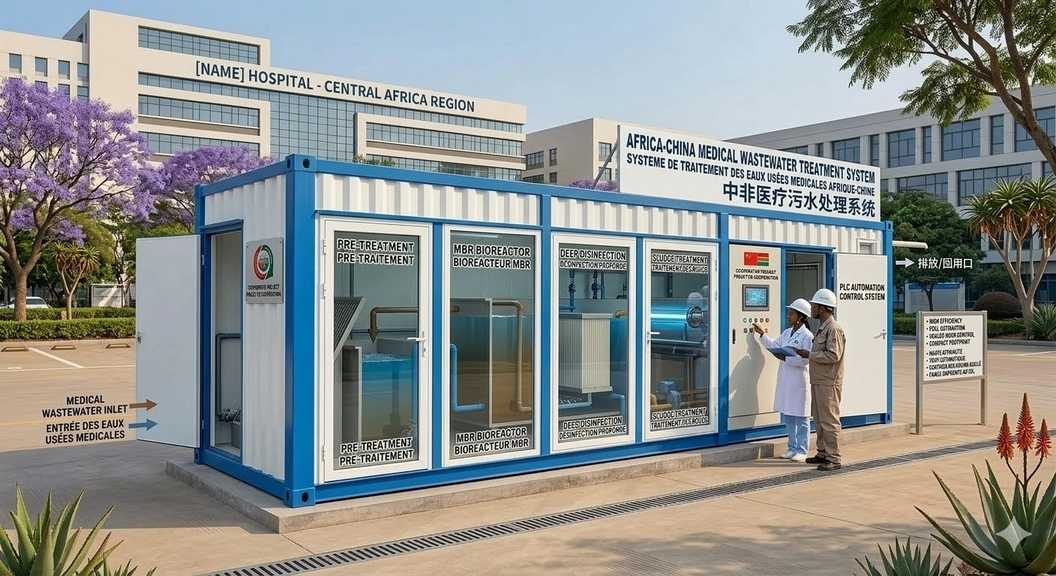
TheAll-in-OneIntegrated Containerized System is the best design for hospitals with no extra land. These systems are pre-built inside a standard shipping container. They can be placed on a rooftop, in a service driveway, or even over a drainage ditch. They provide high-level disinfection and biological treatment in a single, mobile package.

The Power of theAll-in-OneBox

I love the integrated design because it is a “подключи и играй” solution. For a city hospital, time is money. You cannot have construction workers on your site for six months. Our containerized plants are built and tested in our China factory. When the ship arrives in your country, we truck the container to your hospital, connect the “В” труба и “Вне” pipe, and turn on the power.

Inside that one box, we include:

  1. Pre-treatment screen: To catch hair, plastic, and wipes from the hospital.
  1. Equalization zone: To balance the flow from morning showers and busy surgery hours.
  1. Biological zone: Where the bacteria eat the waste.
  1. MBR or MBBR modules: For high-clarity water.
  1. UV or Chlorine Disinfection: To kill 99.9% of germs.

Rooftop Installation: The Final Frontier

If there is no space on the ground, I look up. Many modern hospital buildings have flat roofs. A containerized system is surprisingly light when compared to the weight of a whole building. With a crane and some structural checks by an engineer, we can put your wastewater plant on the roof.

This is great because the smells (if any) blow away in the wind, and the noise is far from the patients. It also uses space that is usually 100% wasted.

Reliability for Medical Use

In a city, you cannot afford a leak or a failure. If your system breaks and spills raw sewage onto a city street, the fines will be huge. That is why I insist on high-quality materials. We use thick, coated carbon steel or high-grade stainless steel for our tanks. Even in the humid or salty air of a coastal city, our systems last for decades.

Performance Standards for Hospitals

When you have no space, you still need high performance. Hospital water is “сильнее” than house water. It has more chemicals. Our integrated designs are specifically made for this.

Параметр Raw Hospital Waste ROAGUA Treated Water Local Goal
BOD (Organic Load) 300 mg/L < 10 мг/л Pass
TSS (Solids) 200 mg/L < 5 mg/L Pass
Bacteria/Viruses Очень высокий 0 / Undetectable Pass
Фармацевтика Present Significantly Reduced Pass

Simple Operation for Busy Staff

I know your hospital staff are doctors and nurses, not wastewater engineers. That’s why our best designs for urban hospitals are fully automatic. I tell my clients:You have enough to worry about in the ER. Let the machine worry about the water.The system will send an alert to your phone via WhatsApp or email if it needs a filter cleaned or more chemicals added. This makes a complex system feel very simple to own.

I hope this guide helps you see that space is not a barrier to clean water. By using MBR technology, vertical stacking, and customized container designs, you can fit a powerful treatment system into any urban hospital.

Would you like me to create a custom layout drawing based on your hospital’s available basement or parking space?