December 20, 2025     منشور من طرف :

Starting a water business is exciting, but I know exactly how frustrating it can be when you talk to suppliers who don’t understand your needs. You are ready to invest, but the technical terms can feel overwhelming.

The main difference lies in the salt content (TDS) of your water source. Brackish water systems handle low salt levels (under 10,000 ppm) using lower pressure, while seawater systems (SWRO) must handle high salt levels (up to 40,000 ppm) requiring very high pressure, special corrosion-resistant pumps, and expensive membranes.

If you get this wrong, you might buy a machine that dies in a month or one that costs too much to run. Let me guide you through the details so you can make the right choice for your business.

How do I decide if I need a brackish or seawater RO design when I import from China?

Many first-time buyers guess what machine they need based on the look of the water, but this is a dangerous game that burns money. You cannot see salt concentration with your eyes.

To decide, you must look at the Total Dissolved Solids (TDS) on a professional water quality report. If your TDS is below 10,000 mg/L, you need a Brackish Water (BWRO) design; if it is above 30,000 mg/L, like ocean water, you absolutely need a Seawater (SWRO) design.

The decision process starts long before you look at machine catalogs or talk to a sales representative on WhatsApp. It begins at the source of your water. In my years running ROAGUA, I have seen many business owners in Africa try to save money by skipping the water test. They tell me,Lucky, the water just tastes a little salty,and they ask for a cheaper machine.

I remember a client from Angola named Pedro. He was drilling a borehole near the coast. He assumed that because the water came from the ground, it wasbrackishwater. He insisted on buying a standard Brackish Water Reverse Osmosis (BWRO) system because it was $5,000 cheaper than the Seawater (SWRO) version. I warned him, but he was focused on the initial price tag.

Three weeks after he installed the machine, he called me in a panic. The machine was vibrating violently, and the water flow had stopped. When we finally got a water report, his TDS was 32,000 mg/L. He was essentially pumping ocean water. The pressure required to treat that water was far higher than his pump could handle, and the salt had crystallized inside his membranes. He had to scrap the entire machine and buy a new one.

To avoid being like Pedro, you must classify your water correctly. Here is a simple table I use to help my clients understand where they fit:

Water Type TDS Range (mg/L or ppm) System Required Common Source
Tap/River Water 0 – 1,000 Low Pressure RO City lines, fresh rivers
المياه المالحة 1,00010,000 BWRO (Brackish) Boreholes, wells, estuaries
Highly Saline 10,00030,000 High Brackish / SWRO Deep wells near coast
مياه البحر 30,00045,000+ SWRO (Seawater) Open ocean, beach wells

Why the Water Report is Your Passport

When you import from China, a professional supplier will always ask for yourRaw Water Analysis Report.If a supplier gives you a quote without asking for this, run away. They are just selling you metal and plastic, not a solution.

The report tells us theOsmotic Pressure.Imagine you are trying to push water through a very tight filter. If the water has a lot of salt (Seawater), the water pushes back very hard. You need massive force to overcome that push. If the water has less salt (Brackish), the pushback is weak.

If you use a Brackish design on Seawater, the pump is too weak to push the water through. No water comes out.

If you use a Seawater design on Brackish water, you are wasting electricity and spent too much money on a heavy-duty pump you don’t need.

So, the first step is simple: Get a bottle of your water, take it to a local lab, and send the result to me. That piece of paper saves you thousands of dollars.

What design differences (pressure, membranes) should I expect for brackish vs seawater systems when I import from China?

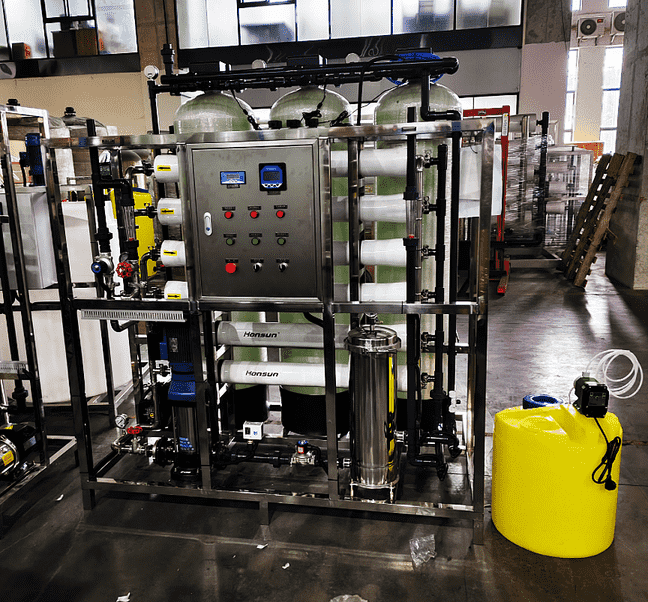
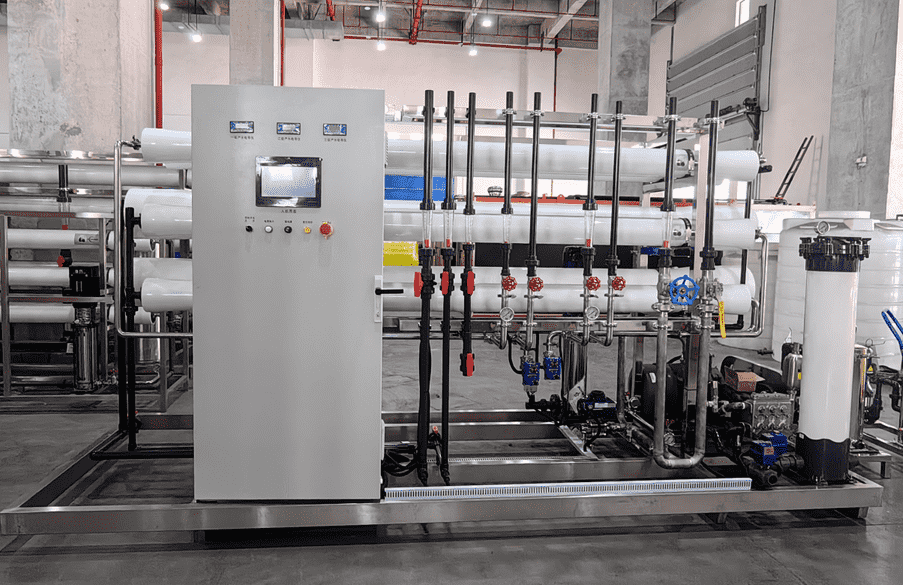
When you look at photos of machines on Alibaba or a website, they often look identical: a frame, some blue cylinders, and a pump. But the internal engineering is completely different.

The biggest design difference is the operating pressure; Brackish systems operate between 150 to 250 psi, while Seawater systems must withstand extreme pressures of 800 to 1,000 psi, requiring reinforced pipes, heavy-duty pumps, and specialized membrane sheets.

Let’s dive into theengineof these machines. When I explain this to my clients who visit our factory in China, I like to use the car analogy. A Brackish Water system is like a family sedan. It is designed for smooth roads and normal speeds. A Seawater system is like a heavy-duty off-road truck. It looks somewhat similar on the outside, but the transmission, engine, and chassis are built to survive extreme stress.

The Heart: The High-Pressure Pump

In a Brackish Water (BWRO) system, the pump is light. It typically uses a vertical multistage pump made of standard stainless steel (SS304). It needs to generate enough pressure to lift water up a small hill—metaphorically speaking. The energy usage is low because the resistance is low.

In a Seawater (SWRO) system, the pump is a beast. We often use plunger pumps or heavy-duty specialized pumps. These pumps must generate 60 bar (approx 870 psi) or more. If you turn on a SWRO pump without securing the pipes properly, the water pressure could cut through soft materials. Because of this high pressure, we cannot use standard plastic pipes for the high-pressure side; we must use high-grade stainless steel or specialized high-pressure hoses.

The Filter: The Membrane Elements

The membrane is the rolled-up sheet inside the blue or white housing that actually cleans the water.

  • BWRO Membranes: These arelooser.They have bigger pores (microscopically speaking) to allow more water to flow through quickly at lower pressures. They are designed to reject about 99% of salt but are optimized for flow.
  • SWRO Membranes: These aretighter.They are built to reject 99.7% or more of the salt. Because they are so tight, they require that massive pressure we talked about to force the water molecule through.


Energy Recovery Devices (ERD)

This is a feature you will almost never see on a Brackish system, but it is critical for a good Seawater system. Because we use so much energy to create that 1,000 psi of pressure, throwing the waste water (brine) away is a waste of energy because that waste water is still under high pressure.

In modern SWRO designs from China, we install an Energy Recovery Device. This device takes the pressure from the waste water and transfers it to the incoming new water. It reduces your electricity bill by 30% to 50%. For a business owner in Africa where electricity is expensive, an ERD is not a luxury; it is a necessity for profit.

Here is a comparison of the technical specifications you might see on a quote from us:

ميزة Brackish Water (BWRO) System Seawater (SWRO) System
Operating Pressure 150300 PSI (1020 Bar) 8001200 PSI (5582 Bar)
Pump Type Vertical Multistage (SS304/316) Plunger or High-Pressure Multistage (Duplex SS)
Membrane Housing Fiberglass (300 PSI rated) Fiberglass (1000+ PSI rated)
معدل الاسترداد 50%75% (High efficiency) 30%40% (Lower efficiency)
Energy Usage قليل Very High (unless ERD is used)

Understanding these differences helps you check the quote. If a supplier offers you a “مياه البحر” machine but the pump is rated for only 300 psi, you immediately know it is a fake or incorrect design.

How can I protect membranes from high salinity or scaling when I import a system from China?

Salt is not the only enemy; hardness and corrosion are silent killers that can ruin your investment in weeks. You need to stop them before they reach the delicate membranes.

You protect your system by using correct pre-treatment technologies like antiscalant dosing to stop mineral buildup, and by ensuring the manufacturer uses corrosion-resistant materials like Duplex Stainless Steel 2205 for all high-pressure parts coming into contact with seawater.

When we ship equipment from China to Africa, I always worry about how the machine will be treated after it arrives. The harsh reality is that seawater is incredibly corrosive. It eats standard metal. If you put standard stainless steel (SS304) in contact with high-pressure seawater, it will rust and leak within months.

The Material Battle: WhyStainlessisn’t enough

For Brackish water, standard Stainless Steel 304 is perfectly fine. It is cheap, shiny, and works well.

For Seawater, SS304 is useless. Even SS316 (which is better) can struggle in hot, salty waters.

At ROAGUA, for our SWRO systems, we use Duplex Stainless Steel (2205) or high-grade plastics for the wetted parts. Duplex steel is stronger and much more resistant to the chloride in salt water. When you read our quote, check the material list. If you seeSS304on the high-pressure pump for a seawater machine, ask for a revision immediately.

Chemical Dosing: The Invisible Shield

Water contains calcium, magnesium, and silica. When you squeeze water through a membrane, these minerals get concentrated. Imagine boiling a kettle until all the water is gone; you see a white powder left behind. That is scale.

Inside a membrane, this scale acts like concrete. It blocks the pores. Once a membrane is blocked with scale, you cannot easily clean it; often, you have to throw it away.

To stop this, we include a Chemical Dosing System.

  1. Antiscalant: We inject a special liquid into the water before it hits the membrane. This chemical surrounds the calcium and magnesium particles and prevents them from sticking together. It keeps them floating so they wash away with the waste water.
  • Biocides: Seawater is full of life (algae, bacteria). These love to grow on membranes (biofouling). We may need to dose chlorine or other biocides to kill them, and then use a carbon filter or another chemical (SMBS) to remove the chlorine right before the membrane (because chlorine also destroys membranes).


The Fresh Water Flush

Here is apro tipI tell all my clients: Never leave saltwater sitting inside the machine when you turn it off.

If you turn off the machine and leave saltwater in the pipes, the water becomes stagnant. Bacteria grow, and corrosion accelerates.

A good design from China will include an Auto-Flush feature. When you pressStop,the machine automatically pumps fresh, clean water through the system for 2 minutes to push all the saltwater out. This simple feature can double the life of your membranes.

Pre-treatment is not Optional

Many buyers try to delete items from the quote to lower the price.Lucky, do I really need this dosing tank? Do I really need the sand filter?

My answer is always:You can remove it, but you will spend ten times the cost buying new membranes every month.

In Brackish systems, pre-treatment is simpler (maybe just a sand filter and carbon filter). In Seawater systems, it is critical. We often look at the Silt Density Index (SDI). If your water is dirty (high SDI), we might even need Ultrafiltration (UF) before the RO system. This acts as asuper filterto remove all the tiny mud and silt so the RO membrane can focus on the salt.

What cost and maintenance implications should I prepare for if I import a seawater-capable system from China?

The sticker price of the machine is just the entry fee; the real cost of ownership comes from the daily electricity and the replacement of parts.

A seawater system generally costs 2 to 3 times more upfront than a brackish system due to specialized materials, and the operating cost is significantly higher because of the large electricity consumption required to generate high pressure.

I believe in being 100% transparent about money. I want your business to be profitable so you come back to me for your second and third machine. If I sell you a machine that makes water too expensive to sell, we both lose.

The Upfront Cost (CAPEX)

Why is the Seawater machine so expensive?

  1. Pumps: A high-pressure SWRO pump costs five times as much as a standard BWRO pump.
  1. Materials: Duplex steel fittings and pipes are expensive.
  1. Pressure Vessels: The housings that hold the membranes must be rated for 1000 psi. These are much heavier and costlier than the 300 psi versions used for brackish water.


The Operating Cost (OPEX)

This is where the profit is made or lost.

  • Brackish Water: You might spend about $0.30 to $0.50 USD to produce 1,000 liters (1 cubic meter) of water. The energy usage is low (maybe 1-2 kWh per cubic meter).
  • Seawater: Without energy recovery, you might spend $1.50 to $2.50 USD per cubic meter. The energy usage is high (3-6 kWh per cubic meter).
  • If you plan to sell bottled water, you need to calculate this. Can you sell the water for enough money to cover the high electric bill?

Maintenance Reality

Maintenance is also different.

  • BWRO: You might clean the membranes (CIPClean In Place) once every 3 to 6 months. Membranes can last 3 to 5 years if treated well.
  • SWRO: You might need to clean the membranes every 1 to 3 months depending on how dirty the ocean water is. Seawater membranes typically last 2 to 3 years because the environment is so harsh.

Here is a breakdown of estimated costs for a typical small factory setup (500 Liters Per Hour):

عنصر التكلفة Brackish Water (BWRO) Seawater (SWRO)
Initial Machine Cost Low ($3,000$6,000 range) High ($8,000$15,000 range)
Electricity Cost قليل High (Main operational expense)
Chemical Costs Antiscalant (Low consumption) Antiscalant + Biocides (Higher consumption)
Membrane Replacement Every 3-5 years Every 2-3 years
قطع غيار Standard, cheap, easy to find Specialized, expensive, must import

Planning for Spares

Since you are in Africa and we are in China, shipping takes time. For a Seawater system, I always advise my clients to buy aCritical Spares Packagewith the initial order. This should include:

  1. One set of replacement seals for the high-pressure pump.
  1. A few extra solenoid valves.
  1. Enough antiscalant chemical for 6 months.
  1. One or two spare membranes.
  1. If a seal breaks on your high-pressure pump in Angola, you cannot easily find a replacement at the local hardware store. If you don’t have the spare part on the shelf, your factory stops for 2 weeks while DHL ships the part. That downtime costs more than the part itself.

Choosing between brackish and seawater systems is not about preference; it is dictated by your water’s salinity report. Seawater systems cost more and use more power, but they are necessary for high-salt sources.

Would you like me to review your raw water quality report for free to tell you exactly which system fits your budget?